
Imagine someone in your area needs an HVAC technician. Instead of scrolling through Google results, they open ChatGPT and ask:
“Can you recommend a reliable HVAC company near me?”
Within seconds, they may receive a shortlist of businesses, explanations of why each might be a good fit, and links to supporting sources.
Now imagine someone asking a similar question through Google's Gemini assistant or AI Mode in Google Search.
The experience may look different, but the underlying question for business owners is the same: Why are certain companies being recommended while others are left out?
There isn't a single, publicly documented formula for getting recommended by AI. Different platforms retrieve information in different ways, and results can change depending on the question, location, and available sources.
Still, there are useful patterns worth understanding, along with practical steps businesses can take to improve how they're represented online.
How AI Finds and Recommends Local Businesses
Traditional local search often presents businesses through map listings, organic search results, reviews, and directories.
AI-powered search can take a different approach.
Instead of simply displaying a list of results, an AI assistant may interpret the user's request, retrieve information from relevant sources, and generate a response identifying businesses that appear to match their needs.
For example, consider these two questions:
- “Find an HVAC company in Fort Lauderdale.”
- “Who repairs air conditioners in Fort Lauderdale on weekends?”
Both concern HVAC services in the same city. But the second question includes a specific requirement: weekend availability.
A company with clear, up-to-date information about weekend service may be easier to identify as a relevant option.
That doesn't establish weekend availability as a formal AI ranking factor. It illustrates how the details of a customer's question can influence which businesses are appropriate to recommend.
The same principle applies to questions about pricing, specialties, service areas, accessibility, and other customer needs.
A Real Example: Finding Coffee Shops With ChatGPT
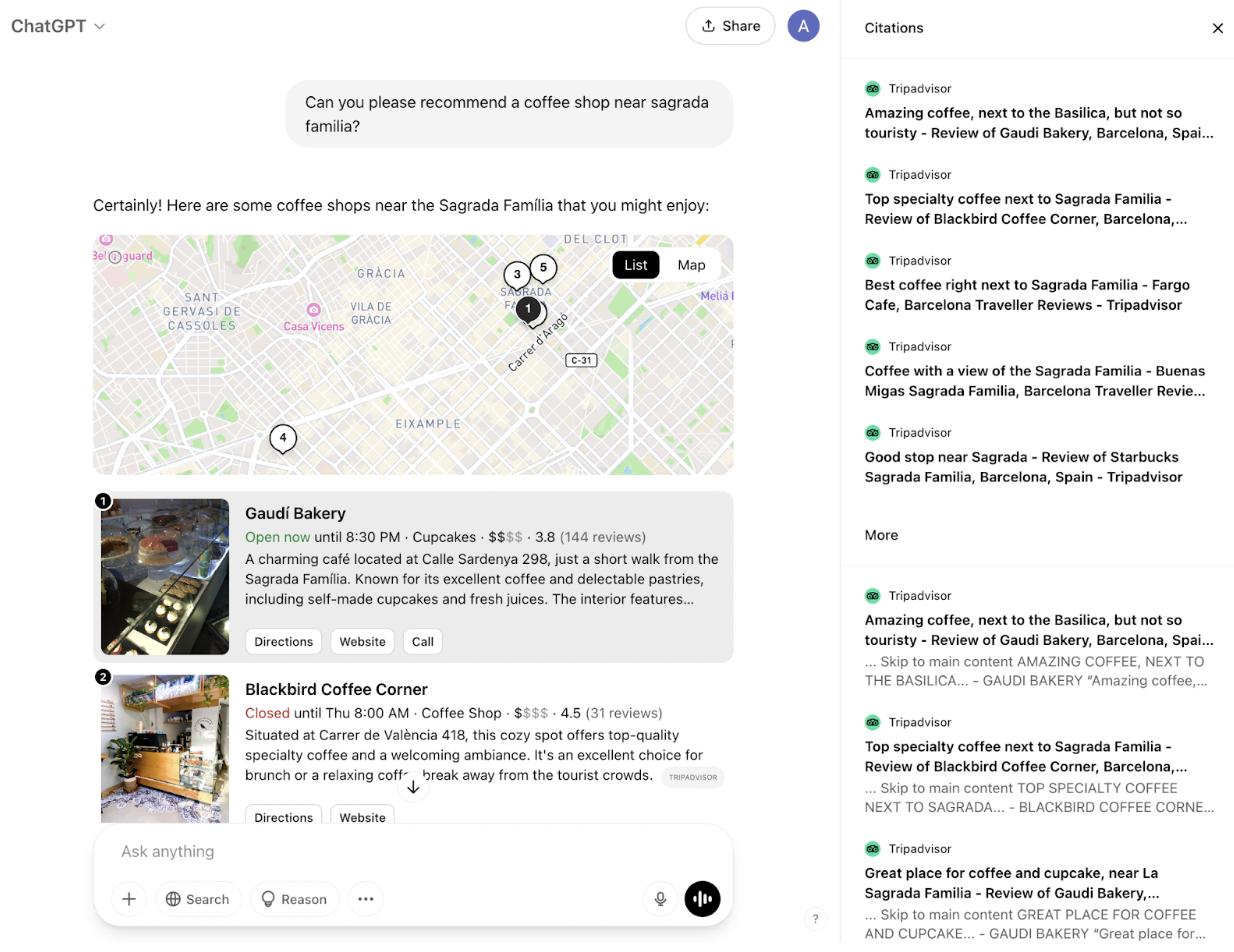
Consider someone visiting Barcelona who asks ChatGPT:
“Can you please recommend a coffee shop near Sagrada Familia?”
In the example below, ChatGPT displays a map, individual coffee shop recommendations, and supporting citations.
The visible citations panel references TripAdvisor pages. This illustrates how third-party websites can contribute information to AI-powered local search.
However, the citations don't establish that TripAdvisor was the only source ChatGPT used or that its reviews determined which businesses were recommended.
 Click to expand
ChatGPT, Gemini, and Google AI Search Aren't the Same Thing
Although these products use AI, they shouldn't be treated as one search engine.
| Platform | How local discovery may work |
|---|---|
| ChatGPT | Can search the web and use location context to identify relevant businesses and supporting sources. |
| Google Gemini | Google's AI assistant can provide recommendations and may use information from Google services and other available sources, depending on the feature and context. |
| Google AI Mode | An AI-powered Google Search experience that can combine information from multiple sources to answer detailed questions, including local ones. |
| Google AI Overviews | AI-generated summaries that may appear within Google Search results for certain queries. |
Google Maps and Google Business Profiles also remain important parts of Google's local discovery ecosystem.
However, appearing prominently on Google Maps doesn't automatically mean a business will be recommended by Gemini, AI Mode, or ChatGPT.
Each experience can surface and present information differently.
A Real Example: Finding a Dentist With Google AI Mode
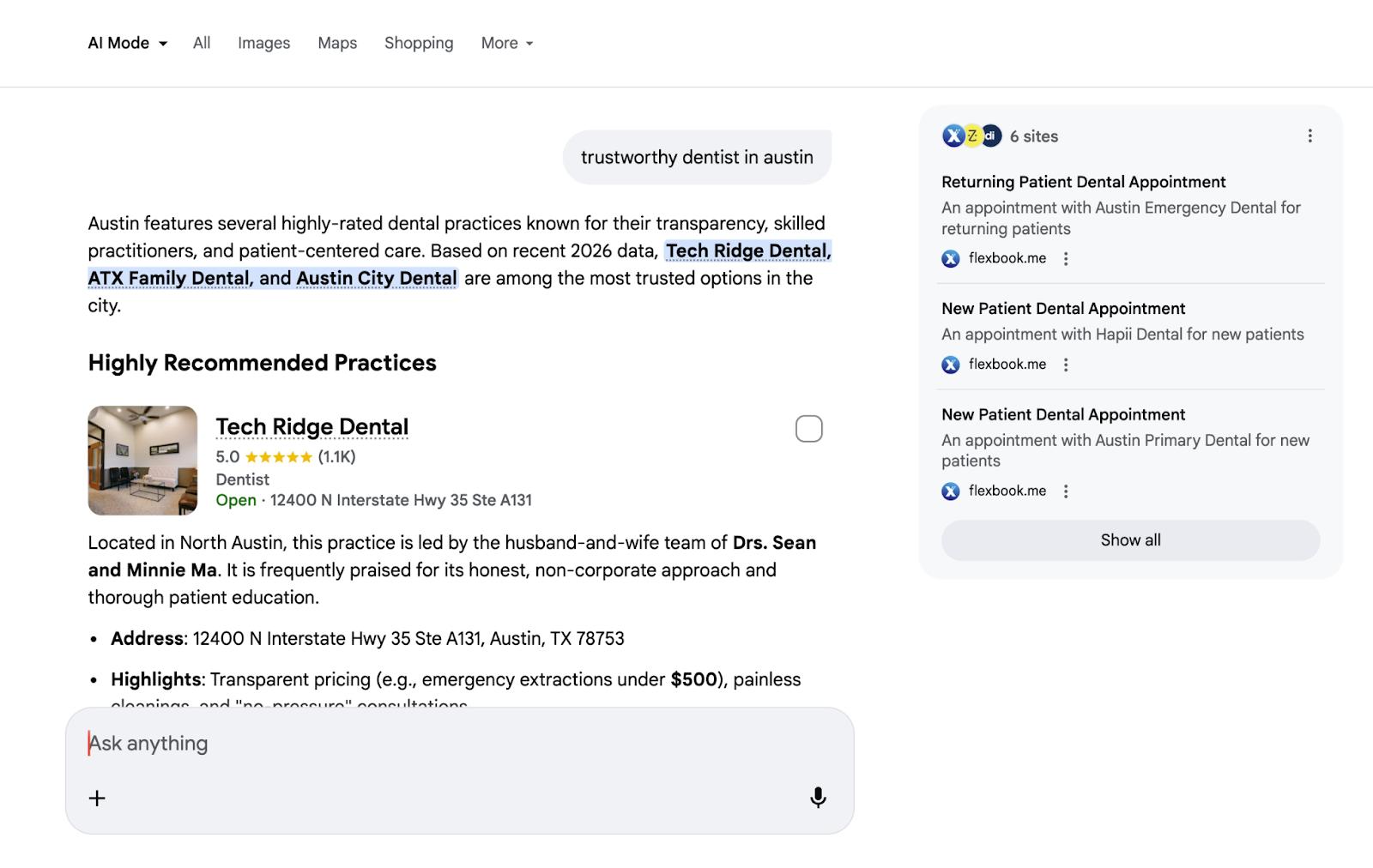
In another example, someone searches for:
“trustworthy dentist in austin”
Google AI Mode responds with dental practice recommendations, ratings, business details, and supporting sources.
The word trustworthy adds an important dimension to the search. Rather than simply requesting nearby dentists, the user is asking for businesses that appear credible and reliable.
The response illustrates how AI-powered search can present information intended to help someone evaluate local businesses.
It does not establish which specific signals Google used to select or order those practices.
 Click to expand
A note on these examples: These screenshots illustrate different local search experiences. They are not a controlled comparison because the platforms, locations, and search prompts differ.
What Influences AI Recommendations for Local Businesses?
No platform publishes a complete formula for determining which local businesses appear in every AI-generated response.
However, research and platform documentation point to several considerations that business owners should understand.
1. Location and Relevance
Location is central to most local business recommendations.
A person asking for a plumber in Miami should generally receive different suggestions from someone looking for one in Fort Lauderdale.
ChatGPT can use approximate location information, and users can provide a more specific location when making a request, as OpenAI describes in its ChatGPT search help article. Google's local search experiences can also use location context.
But location is only part of the equation.
A company must also be relevant to the service being requested.
Consider a plumbing business that specializes in commercial construction. It may be less relevant to a homeowner looking for emergency residential drain cleaning than a company that clearly offers that service.
What businesses should do: Make sure your website accurately describes your services, specialties, and service areas.
Specific, helpful service pages can make this information easier to find and understand.
Avoid creating dozens of nearly identical location pages simply to target additional cities. Focus on information that genuinely helps potential customers.
2. Your Business Website
Your website remains an important source of information in AI-powered search.
BrightLocal's Local AI Visibility Study analyzed more than 200,000 local AI searches across ChatGPT, Google AI Mode, and Google AI Overviews.
The study reported that business websites accounted for approximately 42% of citations across the platforms analyzed.
That finding is significant, but it requires context.
A citation is a source referenced in an AI-generated answer. It isn't necessarily a business recommendation, and the study's overall percentage shouldn't be attributed to ChatGPT or Gemini individually.
Nevertheless, it reinforces the value of maintaining a useful, accessible website.
Imagine two roofing companies.
The first has a basic homepage with a phone number and a short description.
The second clearly explains its repair services, installation options, materials, warranties, service areas, and frequently asked questions.
The second website provides more information that can help customers and search systems understand whether the company matches a particular request.
What businesses should do: Keep your website accurate, accessible, and informative. Clearly explain what you offer, where you operate, and what makes your services relevant to specific customer needs. If your site is outdated or hard to use, website design is often the place to start.
3. Reviews and Online Reputation
Customer reviews are an important part of how people evaluate local businesses.
A homeowner looking for an HVAC technician may care about responsiveness, reliability, professionalism, and whether previous customers were satisfied.
AI systems may encounter this information through business profiles, review websites, and other public sources.
However, there is no publicly confirmed rule stating that a particular star rating or review count guarantees an AI recommendation.
A company with 200 reviews isn't automatically guaranteed to appear ahead of one with 40.
Reviews are best understood as part of a business's overall public reputation rather than a guaranteed AI ranking shortcut.
What businesses should do: Encourage genuine customer feedback, respond professionally to reviews, and maintain accurate profiles on platforms relevant to your industry.
These practices benefit customer trust regardless of how someone discovers your business.
4. Business Listings and Third-Party Sources
Your website isn't the only place where information about your business exists.
Google Business Profiles, Yelp, industry directories, local publications, and other websites can provide information about businesses and their services.
BrightLocal's research on AI directory sources found that the sources cited by AI search experiences vary by platform.
For example, Yelp featured prominently among third-party domains cited in its ChatGPT analysis, while Google Business Profile information was more prominent in Google's AI search experiences.
This suggests that businesses shouldn't assume every AI platform relies on the same sources.
It also doesn't mean that creating a Yelp listing will automatically improve ChatGPT recommendations.
What businesses should do: Maintain accurate information on Google Business Profile and legitimate third-party platforms where customers are likely to research your services.
Focus on relevant, reputable sources rather than submitting your business to hundreds of low-quality directories.
5. Traditional SEO and Search Visibility
Does ranking well on Google help your business appear in AI-generated recommendations?
Potentially, but the relationship isn't straightforward.
Good traditional SEO helps search engines discover and understand websites. Many of the same practices also improve the quality and accessibility of information that AI-powered search systems may retrieve.
These include:
- Clear service and location information.
- Useful, original website content.
- Accessible pages and logical site structure.
- Reputable links and third-party mentions.
- Accurate business information across the web.
However, AI recommendations aren't simply copies of Google's organic rankings or Maps results.
BrightLocal's study found that ranking on Google Maps doesn't translate directly to AI visibility.
The takeaway is that traditional SEO and AI search visibility overlap, but they aren't identical.
For most local businesses, improving their existing website and local search presence is a more practical starting point than abandoning established SEO strategies for unproven AI-specific tactics.
6. Website Accessibility and AI Crawlers
There's also a technical consideration worth checking.
OpenAI uses a crawler called OAI-SearchBot to help discover website content for ChatGPT's search features.
Website owners can control crawler access through their robots.txt file and other technical settings.
OpenAI's crawler documentation advises allowing OAI-SearchBot if you want your website content to be eligible for inclusion in ChatGPT Search.
Allowing the crawler does not guarantee that your business will appear in an answer.
OAI-SearchBot is also distinct from GPTBot, which is associated with model training.
Google's AI search features operate within Google's broader search infrastructure. Google's guidance for AI features generally emphasizes following established Search technical requirements rather than relying on special AI-only optimization tricks.
What businesses should do: Make sure important pages are accessible to search engines and relevant search crawlers. Check for accidental blocking through robots rules, security plugins, or hosting configurations.
Why AI Might Recommend Different Businesses Each Time
One of the biggest differences between AI recommendations and conventional search rankings is consistency.
You might ask ChatGPT for the best HVAC companies in your area and receive five suggestions.
Ask the same question again, and some of those businesses may change.
BrightLocal's research found substantial variation across repeated local AI searches, even when prompts remained the same. Its study reported only 20% to 33% average overlap between result sets on repeat searches.
Several factors can contribute to differences:
- How the question is worded.
- The user's location and available context.
- Which sources are retrieved.
- Changes in business information.
- Variability in the generated response.
This makes AI visibility harder to measure than a traditional keyword ranking.
A business appearing once doesn't prove it will consistently be recommended. Likewise, a business missing from one response isn't necessarily invisible across the platform.
For business owners, repeated testing is more informative than a single screenshot.
How to Check Whether AI Recommends Your Business
You don't necessarily need specialized software to begin investigating your AI search visibility.
Start by thinking about the questions potential customers would naturally ask.
For an HVAC company, those might include:
- “Can you recommend an AC repair company in Fort Lauderdale?”
- “Who installs residential HVAC systems in Broward County?”
- “Which HVAC companies offer emergency repairs near me?”
Try relevant questions in ChatGPT and Google's AI search experiences. You can also test Gemini, keeping in mind that its responses and available features may differ from Google Search.
Record which businesses appear, what the responses say about them, and which sources are provided.
Then repeat the process over time.
You may notice that certain competitors appear frequently. Review their websites, service information, business profiles, and public reputation.
Are they more specific about their services? Do they have clearer location information? Are they mentioned by reputable third-party sources?
These comparisons won't reveal a secret ranking formula, but they may highlight opportunities to improve your own online presence.
For more consistent testing, use the same prompts, specify locations, and record the platform and date. Remember that account context and location settings can still affect results.
What Should Local Businesses Prioritize?
AI visibility is a developing area of digital marketing, and it's easy to get distracted by new terminology or promises of quick rankings.
For most local businesses, the sensible starting point is strengthening their existing online presence.
| Priority | Action | Why it matters |
|---|---|---|
| High | Clearly explain services and service areas | Helps establish relevance to customer questions |
| High | Maintain a useful, accessible website | Provides reliable information about your business |
| High | Keep business listings accurate | Reduces outdated or conflicting information |
| High | Build an authentic review profile | Supports public reputation and customer trust |
| Medium | Publish helpful service-specific content | Answers detailed questions beyond a basic homepage |
| Medium | Check crawler accessibility | Helps prevent avoidable technical barriers |
| Ongoing | Monitor AI recommendations | Identifies visibility patterns and potential gaps |
These are practical marketing priorities, not an official ranking-factor checklist for ChatGPT, Gemini, or Google AI Search.
Can You Guarantee Your Business Will Appear in AI Recommendations?
No reputable provider should promise guaranteed organic placement in ChatGPT or Google's AI search experiences.
The platforms don't publish complete ranking formulas, and their responses can change.
Some generative engine optimization (GEO) services can provide legitimate value by improving technical accessibility, website content, business information, and visibility monitoring.
But those improvements should be judged on their actual usefulness.
Claims that a particular schema markup, directory submission, or AI optimization trick guarantees recommendations should be treated skeptically.
The Bottom Line
AI-powered search is creating another way for customers to discover local businesses.
ChatGPT, Gemini, and Google's AI search experiences don't all operate identically, but they share a basic challenge: identifying relevant businesses using the information available to them.
Location, services, website content, online reputation, and third-party sources can all contribute to that information.
The exact influence of each factor isn't publicly disclosed, and there is no guaranteed shortcut to being recommended.
For most business owners, the best starting point is straightforward: maintain a clear, accurate, trustworthy online presence that helps customers understand what you do and why you're a good fit.
Those fundamentals matter whether someone discovers your business through Google Maps, a traditional search result, ChatGPT, or another AI-powered experience.
Curious how your business shows up?
At ScaleWave Marketing, we help businesses improve their websites, SEO, and visibility across emerging AI search platforms. If you're looking to understand how your business appears in search, you can discuss your business's search visibility with our team.
Sources and Further Reading
- OpenAI: Searching the web with ChatGPT. Official information about ChatGPT Search and location-based responses.
- OpenAI: Overview of OpenAI Crawlers. Technical guidance on OAI-SearchBot and crawler access.
- Google Search Central: AI features and your website. Google's guidance for website owners regarding AI Overviews and AI Mode.
- BrightLocal: Local AI Visibility Study. Research on citations, recommendations, and consistency across local AI searches.
- BrightLocal: AI Directory Sources. Analysis of third-party websites appearing as sources in AI search.